Describe Causal Modeling Using Linear Regression
A sample of students is measured for height each year for 3 years. Lmy x data data_frame_name where.

Predictive Modelling Using Linear Regression By Rajat Panchotia The Startup Medium
Linear Regression has actually been around for a very long time around 200 years.
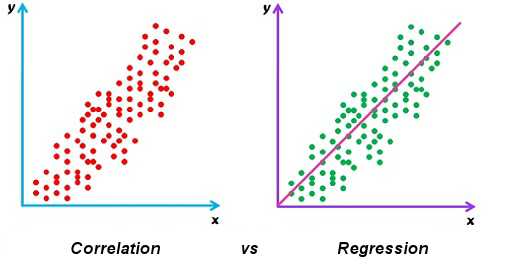
. It is easy to draw questionable causal inferences from a regression. When we say fit we mean find the best fitting line to this data lm stands for linear model and is used as follows. Linear regression is used to study the linear relationship between a dependent variable Y blood pressure and one or more independent variables X age weight sex.
You can run and use regression when theres no causal relationship. The regression coefficient b tells us that for unit change in x explanatory variable y the response variable changes by an average of b units. Detecting non-causal artifacts in multivariate linear regression models corresponding to small singular values of Mand thus to small eigenvalues of XX MMT.
Additionally if Xis statistically independent of often called exogeneity linear regression can be used to estimate the value of the e ect coe cient. Causal models can improve study designs by providing clear rules for deciding which independent variables need to be includedcontrolled for. It is a linear model ie.
More formally an SEM consists of one or more structural equations generally written. Image by the author. Given the values of several inputs the fitted model allows us to predict y considering the n data points as a.
The dependent variable Y must be continuous while the independent variables may be either continuous age binary sex or categorical social status. Write down the mathematical model definition for this regression using any variable names and priors you choose. First we fit the linear regression model to the data using the lm function and save this as score_model.
β 0 intercept. In the philosophy of science a causal model is a conceptual model that describes the causal mechanisms of a system. After the third year you want to fit a linear regression predicting height using year as a predictor.
We now want to find out how Overtime influences Income which should be a very simple questionLet us use linear regression as well because we can easily describe the effect of overtime on income in a single number the slope of the coefficient of OvertimeSo lets grab scikit-learn and do what we can do best. Overview of Linear Regression Modeling. Alternatively updated thanks to comments many violations of causality lead to EepsilonXneq 0.
Standardization and inverse probability weighting IPW. Correlation and causation The ideal basis for forecasting is a causal model. 71 Relationships between variables.
Causal inference using regression on the treatment variable 91 Causal inference and predictive comparisons So far we have been interpreting regressions predictively. See Hernán and Robins 2006 for a nice introduction to these techniques. The answer is not linear regression.
These questions can in principle be answered by multiple linear regression analysis. A single dummy variable represents treatment status and is included in a regression alongside other variables thought to be confounders. Drawing inferences from observational data using a linear regression model although both studies did use other methods as well.
Linear regression implies causality if your covariates are from a controlled experiment and your experiment isolates the hypothesized causal factor well see Linear regression and causality in a randomized controlled experiment. Ill briefly describe them here. Y is the outcome variable followed by a tilde.
β 1 β ρ regression coefficients. For me I find it more helpful to think of regression and ANOVA as special cases of linear models or or okay generalized linear models the reason being that regression comes with some baggage regression was developed as and is still often taught as at least in intro bio stats like classes models with continuous X and ANOVA was developed as and often. Regression model in Sections 75 and 76 including the use of transformations.
To formally explore this idea we first introduce the following generating model for a and c and hence for a0. Is linear the structural equation is written Y X. Regression is the most widely implemented statistical tool in the social sciences and readily available in most off-the-shelf software.
Because the statistics behind regression is pretty straightforward it encourages newcomers to hit the run button before making sure to have a causal model for their data. There are two ways of nonparametric conditioning to recover causal relationships. Be prepared to defend your choice of priors.
It assumes a linear relationship between the input variablesx and a single output variabley. Linear regression is one of the most commonly used predictive modelling techniquesIt is represented by an equation 𝑌 𝑎 𝑏𝑋 𝑒 where a is the intercept b. Using linear regression to establish empirical relationships Marno Verbeek Using linear regression to establish empirical relationships In its most challenging role the linear regression model describes a causal relationship.
The estimated coefficient on the treatment variable represents the causal effect. In such a. They can allow some questions to be answered from existing observational data without the need for an.
You can study causality using linear regression but in and of itself it doesnt say anything about causality. If a suitable set of covariates can be identified that removes confounding we may proceed to estimate our causal effect using a multivariable regression model. We will run a simple linear.
Regression modeling is one of the most important statistical techniques used in analytical epidemiology. The RHS of a regression model to the extent it reflects the conceptual model can get busy and modeling analytically interactions or casual links through mediation analysis is reasonable and often necessary to make the regression reflect the conceptual model being explored. The y here is calculated by the linear combination of the input variables.
Definition 1 ICA based confounding model. Relationship is assumed linear which means that as x increases by a unit amount y increases by a. Principles of regression modeling are left to Chapter 8.
Consider the univariate regression where your coefficient m is intimately related to the correlation coefficient r. σ σ res residual standard deviation. By means of regression models the effect of one or several explanatory variables eg exposures subject characteristics risk factors on a response variable such as mortality or cancer can be investigated.
In Sections 77 and 78 we discuss forecasting by means of simple linear regression. In linear regression models there are only two types of variables. In the multiple linear regression model Y has normal distribution with mean.
This requires strong assumptions and a good understanding of the underlying economic mechanisms. The model parameters β 0 β 1 β ρ and σ must be estimated from data.

If Correlation Does Not Imply Causation Then What Does By Rafael Martinez Gradiant Talks Medium
If Correlation Does Not Imply Causation Then What Does By Rafael Martinez Gradiant Talks Medium

All Assumptions And Implications Of Linear Regression In One Chart By Dan Vanlunen Dvl Towards Data Science


Comments
Post a Comment